English Teaching Resources • 5 min read • Dec 9, 2025 6:20:27 PM • Written by: Anita Alig
Rhetorical Devices – Language Lab
If you write, you want your readers enthralled; if you speak, you want your listeners to hang on every word you utter, whatever the setting. Exemplary oration, gripping storytelling, winning business presentations, and life-changing lectures feature language with power beyond words. Rhetorical devices play a big part in stirring hearts and minds and leaving an audience somewhat changed.
Whether you are teaching small children, convincing investors or addressing the United Nations, becoming cognisant of proven audience-capturing tools and mastering them will augment your impact and potentially shift your writing and public speaking from good to great.
This blog post examines the best-known rhetorical techniques, providing examples and evaluating suitable contexts. At the end, we provide an example of how AI manages to incorporate more than 10 devices in one single, relatively short passage of text. You can then decide on its usefulness and impact.
AI’s efficiency will also painfully illustrate how not to use rhetorical devices and highlight that doing so for the sake of it quickly churns up clichés and uncomfortable pathos.
The oration techniques below necessitate a careful balancing act to have a winning impact. Less is undoubtedly more.
The Four Rhetorical Device Types
First introduced in Ancient Greece by the Sophists, a group of teachers, oration was later developed by Aristotle, Plato, and Socrates, and further expanded by the Romans.
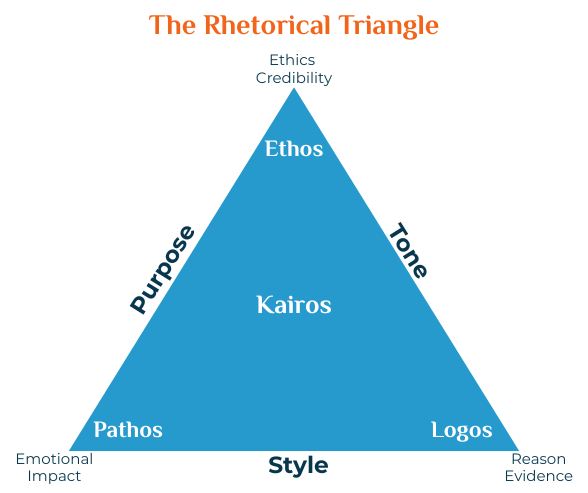
The Sophists were the first to study and teach rhetoric as a means of persuasion. Aristotle created the rhetorical triangle to illustrate the core elements of outstanding oration or writing.
Today’s speakers and writers incorporate all or some of these essential elements to captivate audiences and achieve the desired reaction.
- Ethos: It is essential to appear as an ethical and credible source of information.
- Logos: The words can be backed up with facts, statistics, and solid evidence.
- Pathos: The words grip the audience emotionally.
- Kairos: The words are delivered to the right audience at the right time.
Considered within the context of crafting a text, these four types come into play across all settings: education, politics, business, religion, and the arts, on a daily basis. Even when writing a simple email or making a call, everyone naturally cooks up a blend of these now-ancient engagement techniques.
The Rhetorical Triangle
Aristotle designed a visual representation of the art of oration. The three corners contain the device groups, with the line connecting them denoting the reason and methodology the speaker or writer employs to capture an audience.
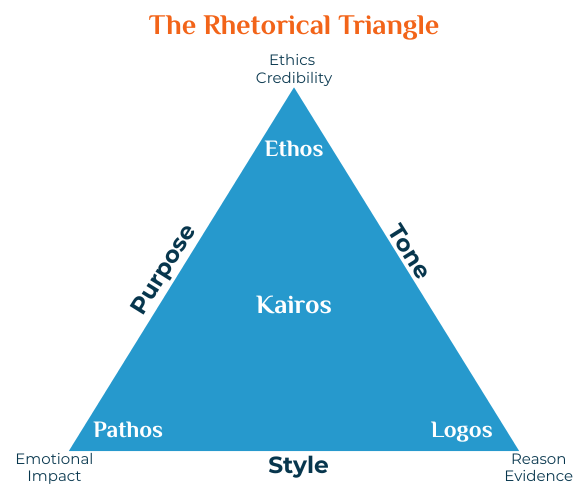
- Purpose: Connects credibility and emotion, the speaker or writer striving to persuade, change, or negotiate.
- Tone: Register, word choice, and style allow the orator or writer to optimise the impact on an audience as long as it is fitting.
- Style: The style is the vehicle for delivery, be that a story, report, film, etc.
Every writer or speaker blends the elements individually, bearing audience expectations in mind. An entrepreneur making a presentation to potential investors will prioritise ethos, whereas a fundraiser will likely dial up the pathos.
Most Impactful Rhetorical Devices with Examples
Most people will know some rhetorical devices, such as alliteration (love, laugh, live), hyperbole (the best ice cream ever), germination (every second of every minute of every hour of every day), simile (quiet as a mouse), and rhetorical questions (Do you want to sweat over your accounts forever?).
Other devices may be nigh impossible to include in today’s world. Cesar’s “I came, I saw, I conquered” is an asyndeton hard to replicate, and JFK’s “Ask not what your country can do for you, but what you can do for your country” is an antimetabole so renowned it takes serious verbal skills to reproduce it.
And some rhetorical devices we hear and get captured by without recognising them:
- Anaphora: Repetition of a word or a phrase: “Real milk. Real beans. Real Quick.”
- Anadiplosis: The second sentence starts with the last word of the first sentence: “Without a healthy economy, we can’t have a healthy society. And without a healthy society, the economy won’t stay healthy for long.” – Margaret Thatcher, 1980
- Epiphora: Multiple sentences finish with the same word/s: “When I was a child, I spoke as a child, I understood as a child, I thought as a child.” New Testament
- Appositive: The subject is followed by a definition: “My neighbour, a world-famous swimmer, hates the ocean.”
- Chiasmus: Here, the second phrase expresses the opposite of the first: “Genuine righteousness leads to life, but the pursuit of evil brings death.” (Proverbs)
- Symploce: Combining anaphoras and epiphoras: “In 1984, we introduced the Macintosh; it didn’t just change Apple, it changed the whole computer industry. In 2001, we introduced the first iPods, and … it didn’t just change the way we all listen to music, it changed the entire music industry.” Steve Jobs, 2007.
- Personification: Giving objects or locations an identity: “The sun doesn’t need permission.”
Great orators often combine multiple rhetorical devices to create. Asking the audience rhetorical questions or planting real or fake doubt are also ways of gripping readers or listeners:
“I am not sure how to tackle this issue. What would you do? All I know is that we must work together.” Something a politician may say.
That is an aporia.
The above is a cross-section of rhetorical devices; many more exist.
AI Does Rhetoric
To introduce more devices and to test AI, I entered the following prompt:
Write a text using as many rhetorical devices as possible.
And this is the result:
The Unstoppable Dawn
Oh, how the night trembles before the coming dawn! Can you feel it—the electric pulse of a new day, thrumming through the silent dark like a drumbeat of destiny? The sun does not ask permission to rise; it blazes, bold and unyielding, painting the sky in strokes of fire and gold. And so must we rise—not with timid whispers, but with the roar of a thousand storms!
Look around you. The world is a stage, and every soul upon it an actor, playing their part in the grand drama of existence. Some falter, some flourish—but all are bound by the same unbreakable thread of time. Time! That relentless thief, stealing moments like a shadow slipping through grasping fingers. Yet, we—yes, we—hold the pen to write our own epic.
Let us be lions where others are lambs, mountains where others are grains of sand! For mediocrity is the enemy, and complacency its silent ally. We were not made to crawl when we were born to soar. The past whispers its lessons, the present shouts its demands, and the future? The future is a blank canvas, waiting for the bold to claim it.
So I ask you—no, I challenge you: Will you be the spark that ignites the fire, or the ember that fades into ash? The choice is yours, but remember: Fortune favours the brave, and history remembers the relentless.
Now—go forth, and let the world tremble at your footsteps!
“Just rhetoric?”
Rhetorical Devices: Use With Caution, Use Sparingly
When writing a speech or a text for readers, it is wise to consider the rhetorical triangle and ensure all elements feature rather than attempting to unleash numerous rhetorical tools.
Following this strategy ensures that you prioritise your audience and engage them in a multifaceted way.
Ultimately, your success will stand and fall with a delicate balance of pathos, logos, ethos, and kairos.